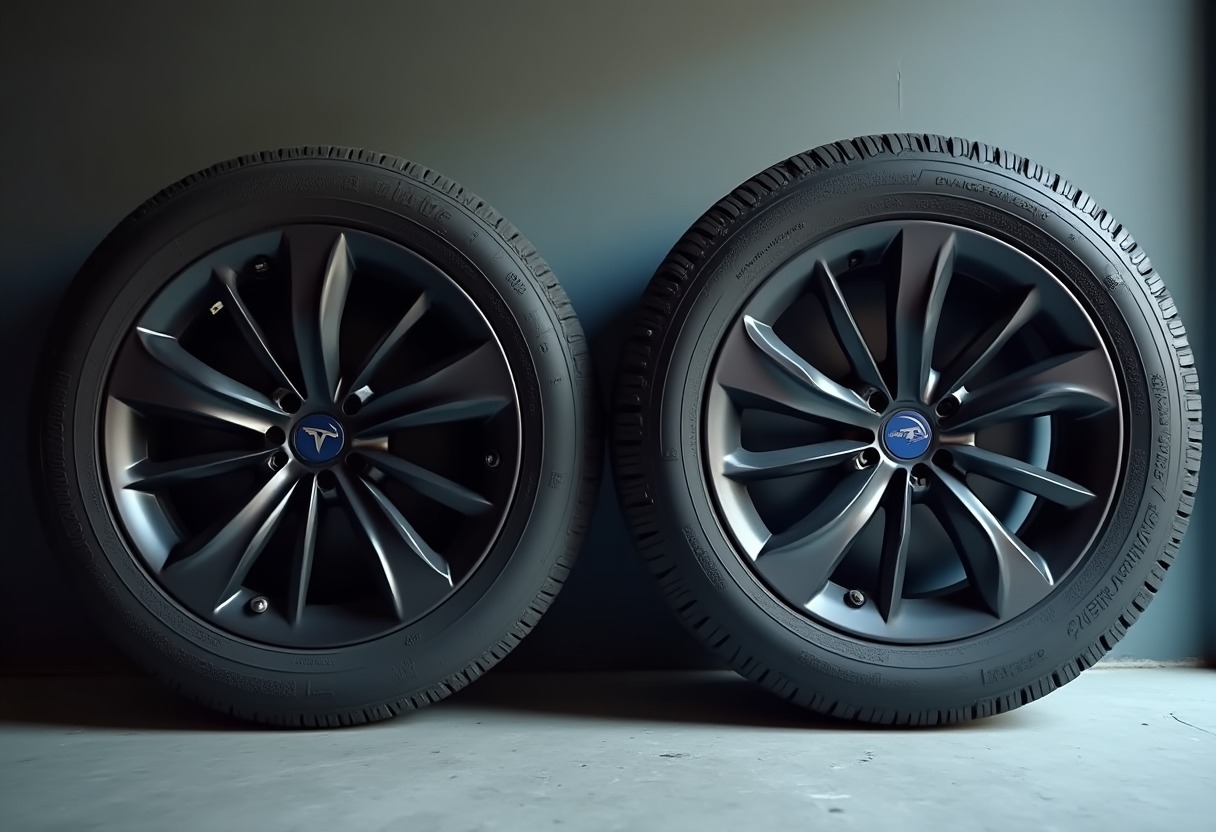
All-season tires on a Tesla lose meaningful grip below 45°F — not in snow, not on ice, but on dry pavement. The compound hardens, contact patch shrinks, and your 4,000-pound Model 3 or Model Y needs 15-20% more distance to stop compared to dedicated winter rubber at the same temperature. Most Tesla owners switch too late, after the first snow, when the real performance drop happened weeks earlier.
Why Temperature Matters More Than Snowfall
Winter tires aren't just about snow traction. The rubber compound in all-season tires starts losing flexibility around 45°F, reducing grip on cold, dry roads. Winter tire compounds use higher silica content and different polymers that stay pliable below freezing, maintaining contact patch integrity down to -40°F.
Consumer Reports testing shows winter tires reduce stopping distance by 30-40% on ice compared to all-seasons, but even on cold, dry pavement the difference runs 10-15 feet from 60 mph. That margin matters when you're piloting a heavy EV with instant torque.
Tesla's instant acceleration amplifies the traction problem. The Model 3 Long Range pushes 346 lb-ft immediately — more than enough to overwhelm all-season tire grip on cold surfaces. Winter tires don't just help you stop; they let you use the acceleration you paid for without traction control cutting power every time temperatures drop.
The weight factor compounds this. Model 3 weighs 4,048 pounds, Model Y hits 4,416 pounds. That mass increases stopping distance and makes tire choice critical. Your regenerative braking helps, but physics still demands tire grip to actually slow the vehicle.
All-Season vs Winter Tire Performance: Real Numbers
| Condition | All-Season Stopping (60-0 mph) | Winter Stopping (60-0 mph) | Difference | |-----------|-------------------------------|---------------------------|------------| | Dry pavement at 40°F | 128 feet | 118 feet | 10 feet | | Wet pavement at 35°F | 156 feet | 138 feet | 18 feet | | Light snow (2 inches) | 195 feet | 142 feet | 53 feet | | Ice at 25°F | 290+ feet | 210 feet | 80+ feet |
These numbers come from independent tire testing on vehicles in the Model 3 weight class. Your actual results vary with tire age, tread depth, and specific models, but the pattern holds: winter tires deliver measurable advantage below 45°F in every condition.
Tread pattern makes the secondary difference. Winter tires use thousands of sipes — thin slits that create biting edges on ice and packed snow. All-season tires have fewer, shallower sipes optimized for wet traction and tread life, not sub-freezing performance.
Tesla OEM all-season tires (typically Michelin Pilot Sport All Season 4 or Continental ProContact RX) work well in their designed range: 45°F and up, dry to moderate wet conditions. Below that threshold, dedicated winter rubber outperforms them in every metric that matters.
When to Actually Switch Tires
Switch to winter tires when daytime highs consistently stay below 45°F, not when snow appears in the forecast. In most northern climates, this means late October to early November. Waiting for snow means you've already driven hundreds of miles on compromised all-season grip.
The reverse threshold matters too. Switch back to all-seasons when overnight lows stay above 40°F consistently — typically late March to mid-April. Running winter tires in warm weather accelerates tread wear (soft compound sheds rubber faster on hot pavement) and reduces fuel economy by 3-5% due to higher rolling resistance.
Storage timing affects this. If you're swapping yourself, plan on 45 minutes per changeover the first time, 30 minutes once you've done it twice. A → Shop portable tire inflator on Amazon saves a trip to the gas station. Torque specs for Model 3 and Model Y lug nuts run 129 lb-ft — use a torque wrench, not an impact gun.
Professional swap costs $50-100 depending on your area. Many tire shops offer seasonal storage for $50-80 per season, which solves the garage space problem if you don't have room for eight wheels and tires.
For Model 3 and Model Y owners in borderline climates (think Seattle, Portland, coastal areas), the calculation shifts. If you see more than 10 days below 40°F and any snow or ice, winter tires justify the cost. If your area rarely drops below 45°F, quality all-seasons work fine. Check local temperature history, not just snowfall records.
Specific Winter Tire Recommendations for Model 3 and Model Y
Michelin X-Ice Snow: Best overall winter tire for Tesla use. Excellent ice grip, long tread life (45,000+ miles reported by Model 3 owners), low road noise. Efficiency hit runs about 4% compared to OEM all-seasons. Stiff sidewall handles the weight well. Popular sizes for 18" and 19" Tesla wheels available.
Bridgestone Blizzak WS90: Maximum ice and snow traction at the cost of faster tread wear. Expect 30,000-35,000 miles. Noticeably softer ride than X-Ice Snow. If you face serious winter conditions (upper Midwest, mountain regions), this delivers the grip you need. Range penalty runs 5-6%.
Continental VikingContact 7: Strong balance of winter performance and efficiency. Road noise sits between X-Ice and Blizzak. Tread life runs 38,000-42,000 miles. Harder to find in stock but worth checking — some Model Y owners report better range retention than other winter options.
Nokian Hakkapeliitta R5 (studless): Finnish engineering optimized for severe winter. Expensive but exceptional on ice. Range hit runs 6-7%, but if you live where winter means winter (Canada, Alaska, mountain states), the traction justifies it. Tread life hits 40,000+ miles despite soft compound.
Match wheel size to your Tesla configuration. Model 3 typically runs 18" (235/45R18) or 19" (235/40R19) depending on trim. Model Y uses 19" (255/45R19) standard or 20" (255/40R20) on Performance. Winter wheel and tire packages cost $1,200-2,000 depending on wheel quality. Steel wheels work fine and cost less, but verify Tesla brake caliper clearance — some Performance models need specific wheel designs.
A → Shop tire tread depth gauge on Amazon helps you monitor wear. Replace winter tires when tread depth hits 5/32" (all-seasons can run to 4/32", but winter tires lose snow traction before that threshold).
Pressure, Storage, and Maintenance Reality
Winter tire pressure needs adjustment. Cold air contracts — expect to lose 1-2 PSI for every 10°F temperature drop. Tesla recommends 42 PSI front and rear for most configurations. Check pressure weekly during temperature swings, monthly once weather stabilizes.
Tesla's TPMS (Tire Pressure Monitoring System) requires relearning when you swap wheels. The car handles this automatically after driving 10-15 minutes above 15 mph. If the warning persists, the service menu lets you manually trigger a reset. Some owners install a second TPMS sensor set in their winter wheels to avoid the relearn process — costs about $200-250 for four sensors.
Tire storage matters for longevity. Stack tires flat (not standing) in a cool, dry location away from direct sunlight and ozone sources (furnaces, electric motors). → Shop tire storage bags on Amazon prevent dry rot and keep your garage clean. Clean tires before storage — brake dust and road grime degrade rubber over time.
Rotation schedule differs for winter tires. Tesla recommends rotating every 6,250 miles for all-seasons. Winter tires see harder service in worse conditions, so rotate every 5,000 miles. Most owners only put 4,000-6,000 miles per winter season, meaning one rotation mid-season handles it.
If you're running winter tires on the original Tesla wheels, you're swapping rubber only, not wheels. This costs $80-120 per swap at most shops and risks damaging TPMS sensors over time. Dedicated winter wheel sets eliminate that risk and make DIY swapping practical. Many Model 3 and Model Y owners buy cheap 18" steel wheels for winter use, which also protects expensive OEM wheels from salt and road damage.
For winter driving tips beyond tires, check out our Tesla Winter Accessories guide for cabin preparation.
What Most Guides Miss: Range Impact and Driving Mode
Winter tires cost you range — expect 8-12% reduction compared to Tesla's OEM all-seasons. A Model 3 Long Range rated for 358 miles might drop to 315-330 miles on winter rubber. Cold weather already hits range hard (battery chemistry slows below freezing); winter tires compound this.
The range penalty comes from three factors: higher rolling resistance (softer compound), increased weight (winter tires often weigh 2-3 pounds more each), and different tread patterns that create more road contact and friction.
You can minimize this. Keep tire pressure at the upper end of Tesla's recommended range (42 PSI). Disable aggressive preconditioning when you don't need it. Use Range Mode in the driving settings menu — this reduces climate control load and moderates acceleration.
Regenerative braking behavior changes on winter tires. The car limits regen when it detects reduced traction, showing a dotted line instead of solid on the power meter. This protects against wheel slip during deceleration. You'll use mechanical brakes more, which feels different but works fine. The system adapts after a few miles of driving.
Acceleration mode choice matters. Chill mode reduces torque delivery and makes throttle input gentler, which helps prevent wheelspin in snow and ice. You sacrifice some performance, but winter tires aren't about 0-60 times — they're about predictable, controlled power delivery when traction is marginal.
Some Model 3 and Model Y owners run staggered setups (winter tires only on drive wheels) to save money. This works on rear-wheel-drive Model 3 Standard Range but fails on Long Range and Performance models with all-wheel drive. You need matching tires on all four corners for the dual-motor system to work correctly. Mismatched tires confuse traction control and can cause premature component wear.
FAQ
How much do winter tires actually cost for a Tesla Model 3 or Model Y? Expect $600-900 for four quality winter tires (Michelin X-Ice, Blizzak) mounted on your existing wheels. Add $400-800 for a dedicated winter wheel set if you want to swap yourself. Total first-year cost runs $1,000-1,700; subsequent years just require seasonal swaps at $50-100 each.
Can I use all-season tires year-round in moderate winter climates? Yes, if your area rarely drops below 40°F and sees minimal snow or ice. Quality all-seasons like Michelin CrossClimate 2 or Continental PureContact LS with 3PMSF (three-peak mountain snowflake) rating handle light winter conditions adequately. You give up 20-30% of the winter performance but avoid the swap hassle.
Do winter tires require different wheels, or can I mount them on my Tesla's stock wheels? You can mount winter tires on stock wheels, but buying a dedicated winter wheel set makes seasonal swaps faster and protects your OEM wheels. Most Model 3 and Model Y owners buy inexpensive 18" wheels for winter to avoid paying for tire mounting twice annually and to prevent road salt damage to factory wheels.
How long do winter tires last on a Tesla? Expect 3-5 winter seasons (30,000-45,000 miles) depending on tire model and driving habits. Michelin X-Ice typically lasts longest; Bridgestone Blizzak wears faster but grips better. Replace when tread depth hits 5/32" — winter tires lose snow performance before they look worn out.
Does Tesla recommend specific winter tire brands? Tesla doesn't officially endorse specific winter tire brands but lists compatible sizes and load ratings in the owner's manual. Most Tesla service centers stock or recommend Michelin, Bridgestone, or Continental winter tires. Verify the load index matches your vehicle's requirements — Model Y needs higher load rating than Model 3.
The Bottom Line
Switch to winter tires based on temperature, not snowfall, and you'll spend the entire cold season with better grip, shorter stopping distances, and more usable acceleration. The cost justifies itself the first time you need to stop quickly on a 38°F wet road at 6 AM. All-season tires work in their designed range; winter tires expand the range where your Tesla performs as intended.
Some links on this page are affiliate links. We may earn a small commission if you purchase through them, at no extra cost to you.
As an Amazon Associate we earn from qualifying purchases. This article contains affiliate links; if you buy through them we may earn a small commission at no additional cost to you.